We obtain this identity by first, applying the product rule (marking which vector is acting on) and then we expand using the BAC-CAB rule.
Gradient of a dot product
(the dot marks where the derivative acts on). But applying the BAC-CAB rule to the cross product of a curl, , one of the terms appear. Making and substituting, we find
The MHD equations
Ohm's law
The simple Ohm's law seen in introductory Physics courses is
or .
In 1D, one can see that , and substituting and , we get
and defining , we obtain the Engineering version of Ohm's law, .
For our case, we have to consider that the magnetic field
contributes to the force on charges, so we have to modify Ohm's law t .
Ampère-Maxwell equation
For astrophysical plasmas with , we ignore the displacement current term. So,
Induced electric field
Combining Ampère's and Ohm's laws,
For astrophysical plasmas, is more relevant than , because charges are well mixed.
Induction equation
Faraday's law says
Substituting the induced electric field,
where .
For getting this, we apply the "BAC-CAB" rule for gradients. One of the terms will be . is called the advection term.
Euler equation
We have to modify the plasma momentum equation with the following substitution
to account for the Lorentz force.
Substituting (with Ampère's law), using the gradient of a dot product when both vectors are equal we find
The first new term is the magnetic field pressure and the second term, the magnetic tension force, which tends to straighten magnetic field lines.
Summary
For an astrophysical plasma, there is a system of two vector equations:
The usual goal is to solve for and . MHD is ideal if . This equation has SI units, for Gaussian, we use the transformation which leaves the first equation invariant and the second one, with .
Magnetic flux and Alfvén's theorem
Magnetic Reynolds number
We can compare the effects of both terms in the induction equation by defining
where is a typical length scale where the changes in occur ( is the replacement of the derivative ).
For an astrophysical plasma, is very large, compared to a laboratory plasma. Then, the induction equation can be written as for a laboratory plasma and for an astrophysical plasma.
Magnetic flux
Magnetic field that crosses a surface S of area : .
Alfvén's theorem of flux freezing
The Lagrangian derivative of the magnetic flux is
This derivative means a derivative in a comoving frame. This is very important.
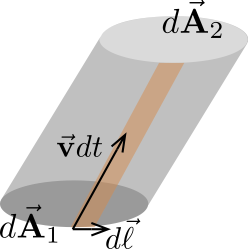
We need to compute the change in the area differential. This can be computed by noticing that its motion sweeps a cylinder (the full area to integrate is composed of small loops that delimit ).
Since the integral of the vector area of a closed surface is zero,
Then,
Note that if the magnetic field is static (time derivative = 0), a configuration that works is a velocity field that is parallel to the magnetic field. The flux freezing theorem means that the magnetic flux is conserved and that if one moves the plasma, the magnetic field lines must also move with it (it's frozen).
Plasma waves waves
Alfvén waves
Consider a static () plasma threaded by a magnetic field like in the first figure. Now imagine there is a small perturbation perpendicular to the original magnetic field, accompanied by a small perturbation of the magnetic field also in the same direction.
We will only discuss what happens using order of magnitude calculations. For this we ignore external forces and the thermal pressure gradient. If we replace the time derivatives by (a characteristic propagation time of the perturbation) and the gradients by (a characteristic propagation distance of the perturbation) and think in 1D (imagining that we know already that the perturbation propagates along the magnetic field line), we get
Substituting (the characteristic speed of propagation of the perturbation), we arrive at
If a perturbation is small (), it propagates with the Alfvén speed as a wave. Then we say that the velocity field is guided by the magnetic field. We say that the flow is sub-Alfvénic.
If a perturbation is very large (), it won't have chance to propagate as a wave. As a consequence, the perturbation drags the magnetic field line with it. We say that the flow is super-Alfvénic.
Magnetoacoustic waves
f we don't ignore the thermal pressure gradient, the perturbation produces a combination of Alfvén and sound waves.