A sequence is a function (real sequence) or (complex sequence), such that one obtains the set for . Some sequences converge to a limit value for .
Series
One can do a partial sum of the elements of a sequence (in numpy, for an array: np.cumsum() ):
the last element of the partial sum (the sum of the all the elements of the sequence up to infinity) is the series. Some series converge to a given value (i.e., the last element of the partial sum for a real series).
Periodic function
A function is periodic with period if for all .
Examples: , are periodic functions with period . The function is -periodic for , .
How to change the period of a function: if has period , has period . Exercise: show this! (hint: use the definition of periodic function).
Inner product of two periodic functions
given functions with period , the inner product is defined as
There is a normalization factor . The bar means complex conjugation. Similar to other vector fields (like forces or velocities), two functions can be orthogonal when their scalar product is zero, and orthonormal if One can define the normalization factor if needed using the orthonormalization condition.
Cauchy's principal value (CPV)
For a function the limiting value is called the Cauchy's principal value, if it exists.
Distributions
Heaviside's function
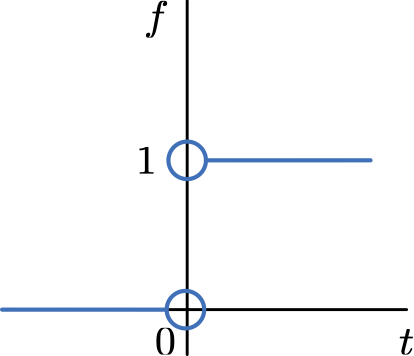
The Heaviside function is a piecewise function
There are different conventions for (). By translation, has the jump at ,
Distributions or generalized functions
They extend the concept of function such that certain derivatives or integrals exist despite the function not being continuous and infinitely differentiable. Distributions are often defined in terms of a limit involving classical functions.
Dirac delta
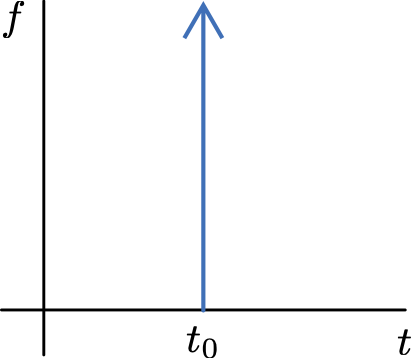
It is a distribution defined by
such that given a continuous function g,
The Dirac delta can be defined by using several representations. Here we review two of them:
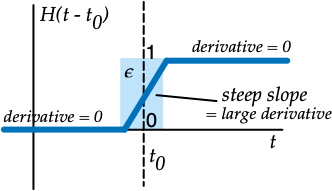
As a derivative of the Heaviside function
The Dirac delta is the derivative of the Heaviside function: . This can be shown by approximating the Heaviside function by continous functions where the 0 and the 1 are connected by a line within an around . As the line becomes more vertical and therefore the derivative (slope) becomes infinite at only one point (just like the Dirac delta).
Integral representation
The Dirac delta can be defined as To understand this conceptually, one can think of the integral Functions similar to have a spike at and vanish for big t, similar to a Dirac delta.
Properties of the Dirac delta
Scaling
For , because (the absolute value is necessary to keep the integration limits).
From the scaling property
Generalization with a function: , where the are all the roots of .
Example: for .
In n dimensions, .
Distribution
because .
In general, for .
As a series of orthogonal functions (closure relation)
If we expand a function in orthonormal functions, we find
but then, if we rearrange,
and this is only true if
This is called the closure relation, and it is the analogous of
which comes from orthogonality.
Example: the spherical harmonics are orthonormal base functions, so this becomes